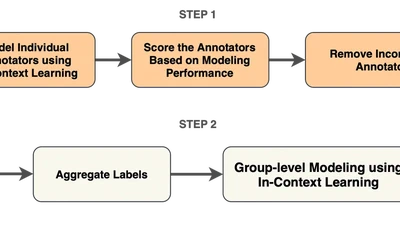
ARTICLE: Annotator Reliability Through In-Context Learning
Using LLMs to identify high-quality human annotators by checking if their labels are consistent with AI predictions—helping build better training data while preserving diverse …
Sujan Dutta
•
•
1 min readProRefine: Inference-Time Prompt Refinement with Textual Feedback
ProRefine automatically improves AI prompts during inference by having one AI agent give feedback to refine another agent's prompts—boosting accuracy by 3-37% and helping smaller …
Deepak Pandita
•
•
1 min readRater Cohesion and Quality from a Vicarious Perspective
Asking people to predict how others with different political views would label content reveals hidden biases and improves data quality for content moderation AI.
Deepak Pandita
•
•
1 min read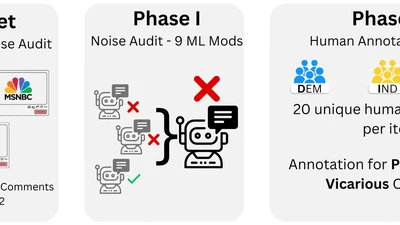
Vicarious Offense and Noise Audit of Offensive Speech Classifiers: Unifying Human and Machine Disagreement on What is Offensive
We ran a massive experiment: 9 different AI content moderation systems analyzed 92 million YouTube comments about US politics. The results were shocking—different AI systems …
Tharindu Cyril Weerasooriya
•
•
1 min readSubjective Crowd Disagreements for Subjective Data: Uncovering Meaningful CrowdOpinion with Population-level Learning
CrowdOpinion uses unsupervised learning to group similar content and predict the full range of human opinions about it, rather than forcing everyone into a single 'correct' …
Tharindu Cyril Weerasooriya
•
•
1 min readDisagreement Matters: Preserving Label Diversity by Jointly Modeling Item and Annotator Label Distributions with DisCo
Tharindu Cyril Weerasooriya
•
•
1 min readFindings from the Bambara - French Machine Translation Competition (BFMT 2023)
Ninoh Agostinho Da Silva
•
•
1 min readVicarious Offense and Noise Audit of Offensive Speech Classifiers
Testing 9 different AI content moderation systems on 92 million YouTube comments reveals wildly inconsistent results, while human annotators show strong political bias—proving that …
Tharindu Cyril Weerasooriya
•
•
1 min readImproving Label Quality by Jointly Modeling Items and Annotators
Tharindu Cyril Weerasooriya
•
•
1 min read